

Dual belief, folk religion and pocket shrines: SLAVTOBER Week 3
Both folklore and religion are rich in spiritual meanings and magical thinking. But how do they intersect? We think of religious art as rigid and contained in a strict canon. But in the world of folk art, the religious and “pagan” can often be intertwined due to complicated history of religious colonisation. I see the dual belief as evidence of magical thinking in both organised religion and the folk beliefs, as well as the proof of the folk traditions that survived the centuries of Christianity’s attempt at erasing them from Slavic soil.
Working with religious themes can be a sensitive topic to many of us, but I wonder if we can reclaim some of its more comforting symbols and meanings and turn them into something healing?
Slavtober is a month-long celebration of Slavic / Eastern European folklore and creativity, hosted across my online platforms (instagram + newsletter + tiktok).
I’ve been hosting it on and off since 2020, hoping to gather a community of artists and folklore enthusiasts, share the wonders of Slavic folklore with others and create a space for us to share our folk-inspired artwork. Over the past 6 years that’s exactly what happened, and I’m so excited to host Slavtober once again in 2026!

WEEK 3 PROMPT IS:
SHRINES AND CHAPELS
Week 3 of Slavtober is dedicated to the folk traditions that survived the centuries of Christianity’s attempt at erasing them from Slavic soil. The pre-Christian symbols and rituals became either appropriated by the church (like pisanka eggs for Easter, “All Saints Day” for autumn equinox and so on) or ended up existing alongside the Christianity in what folklorists call the dual belief. We’ll talk about folk catholicism and the craft of roadside chapels.
I want to encourage you to think about decolonizing folklore and heritage, and to questions the conservative concepts and traditions that seemingly “have always been there”. I’m taking this opportunity to reclaim some Catholic imagery (with which I have very mixed memories and feelings) and to create a holy image of a kind - one that serves me and my own story. I hope you’ll join me.
What does your personal shrine look like?
LOOKING AT ROADSIDE CHAPELS AS FOLK OBJECTS:
Found at the countryside crossroads or hidden in the city walls, the Virgin Mary chapels have fascinated me since childhood and feel intensely nostalgic despite my mixed memories connected to the Polish Catholic upbringing. The cult of Virgin Mary is huge among Polish Catholics, and these chapels are often built for her and decorated with ribbons and flowers. They’re clearly micro-temples and spots of religious cult open for anyone passing by.
But in the older, more localised roadside chapels hides a strange beauty of local folk craft.
The one you see below stood at the crossroads near my grandad’s house in rural Poland (and guys, content warning for my super millenial glasses):
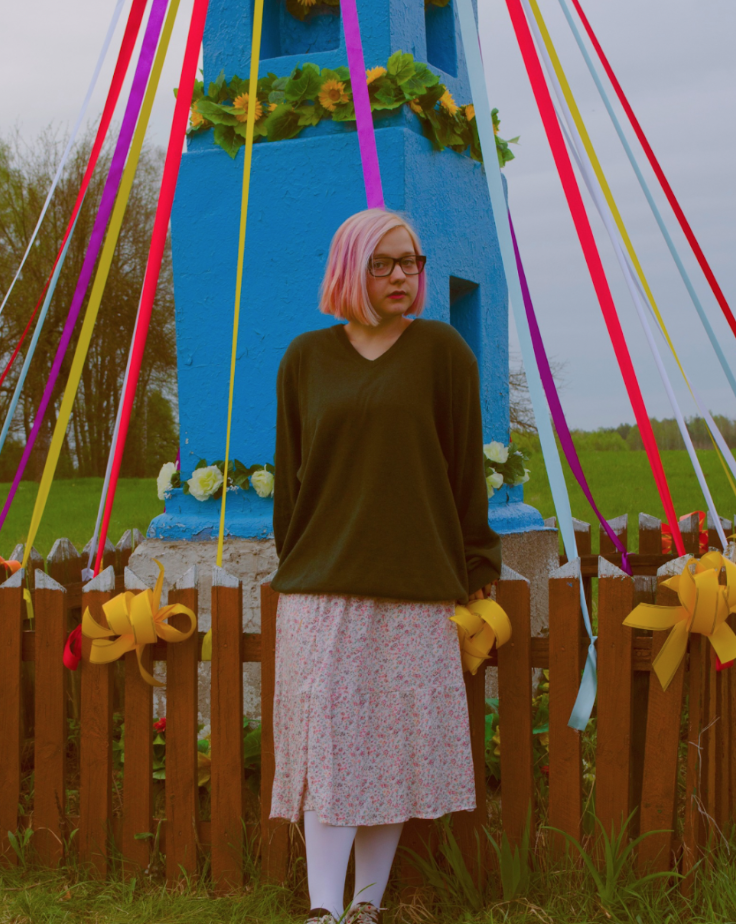
Photo taken by my brother around 2012.
Decorated by the locals with rainbow ribbons and artificial flower arrangements, this bright blue shrine wasn’t a huge place of prayer. But every time we passed it, it felt like we have arrived home, and it was a main colourful landmark in the area. I do wonder who took care to display the ribbons, to touch up the paint and perhaps replace the flowers after the winter’s frost.
Sadly, this chapel isn’t there anymore, now replaced by a cold marbled slab funded by the local parish. The ribbons are gone, and the shrine lost all its character and life. With it, and with the new builds surrounding the area, the shrine kinda lost its power. I’m aware of how the blurred memories and the distance of time passed prompt me to romanticise that moment in time. But I can’t help but wish I could walk by it again and see if I still feel the same thing.
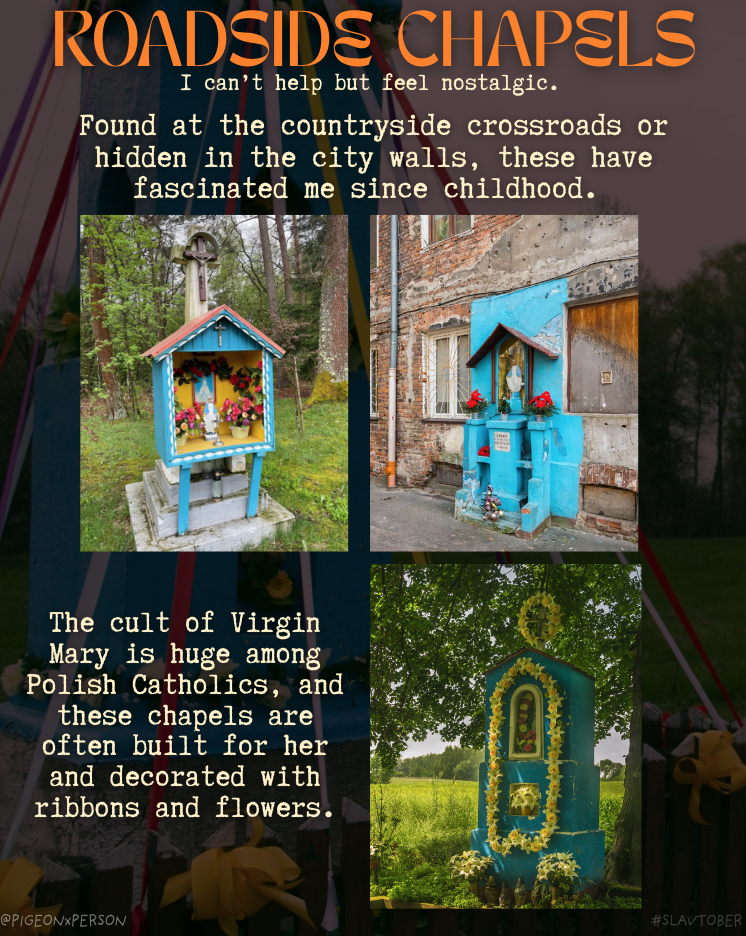
HOW ABOUT…A KNITTING MARY?
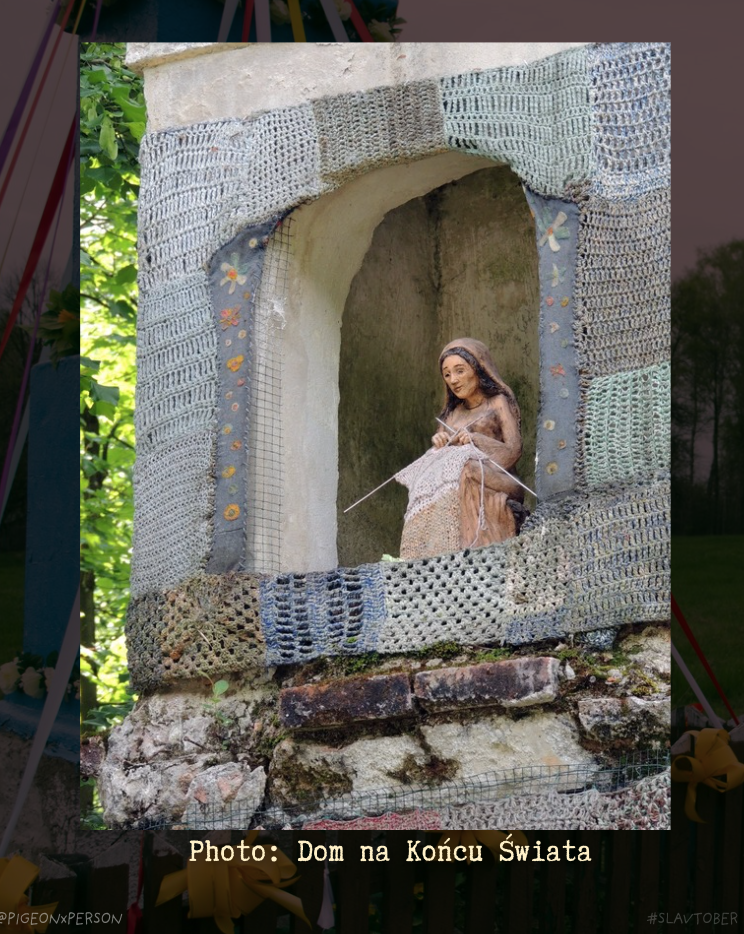
I keep thinking about these chapels as the spot of showcasing local creativity. Among the most unique ones is this chapel in the Bystrzyckie Mountains, with a figure of Virgin Mary knitting.
Covered in knitted patchwork, this chapel says something very intimate about the community it’s serving. I couldn’t find any details for where this one came from. But the small figure cheers up knitters and crafters who happen to pass by.
SZEPTUCHA: FOLK CHRISTIANITY AND DUAL BELIEF
Let’s move to more evident example of the folk and the Christian co-existing: Szeptucha. These so-called Whisperers still live in rural Podlasie in Eastern Poland, and embody a (sadly disappearing) folk tradition.
These older women serve their communities with a healing practice that embodies the dual belief. Their practices often mix prayers to Orthodox saints with rituals involving fire rituals or special gestures. Regardless of your belief, Szeptuchy (plural) are fascinating and respected among many.

Whisperer illustration created for Slavtober 2022. Also available as an art print in my Pigeon Shoppe!
AND NOW, IT’S YOUR TURN.
The interpretation of this prompt is entirely up to you.
I encourage you to look into the spirituality and religion around you with a critical eye, and to reflect on how certain visuals and meanings can help you on your journey.
Is there a conflict between old and new, between the pressure of religion or the past and calling of your heart?
What would your personal shrine look like? Is it dedicated to a specific person or concept?
What kind of artwork can reflect on finding the balance and portraying something spiritual important to you?
What figures and symbols bring you comfort and safety?
JOIN US:
Share your creations online and remember to tag me and use the hashtag #slavtober - I’d love to see them!!
Make yourself comfortable and stay here for Week 3 of Slavtober, where we’ll talk about pocket shrines and dual belief.